Do Vets Recommend Yak Chews? What Do Veterinarians Say About Their Safety and Benefits?
A closer look at where veterinarians agree, where they don't, and how to size, supervise, and store yak chews so the benefits outweigh the risks.
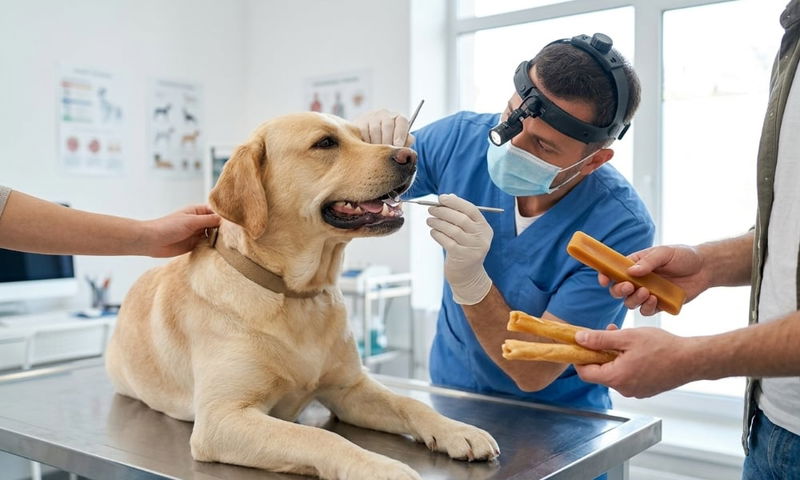
Yak chews are long-lasting natural dog chews made from hardened Himalayan cheese, valued for their high-protein composition, extended chewing time, and minimal ingredient list. Veterinarians generally evaluate yak chews based on a dog's age, dental health, chewing style, bite force, and overall risk of tooth injury rather than treating them as universally safe or unsafe. Veterinary dentists recognize that yak chews can provide mental enrichment, satisfy natural chewing instincts, and contribute to mechanical plaque removal, but their dense structure also places them among the harder recreational chews that require careful sizing, supervision, and appropriate candidate selection.
Veterinary recommendations for yak chews depend on balancing their benefits against potential risks such as dental fractures, choking, and gastrointestinal obstruction. Healthy adult dogs with strong teeth and moderate chewing habits are typically considered the best candidates, while puppies, senior dogs, aggressive power chewers, and dogs with existing dental disease often require softer alternatives. This guide examines what veterinarians and veterinary dental experts say about yak chew safety, reviews the scientific evidence behind their benefits and risks, compares yak chews with rawhide, bully sticks, and synthetic chews, and explains how to choose, size, and use them safely for different dogs.
What Are Yak Chews and Why Are They Popular?
Yak chews are hardened cheese-based dog treats made in the Himalayan foothills of Nepal, Tibet, and Bhutan from a centuries-old dairy recipe. Their popularity comes from three factors: extreme chew longevity, a single-ingredient nutrition profile, and a byproduct origin story that appeals to owners seeking low-waste pet products.
What Are Yak Chews Made From?
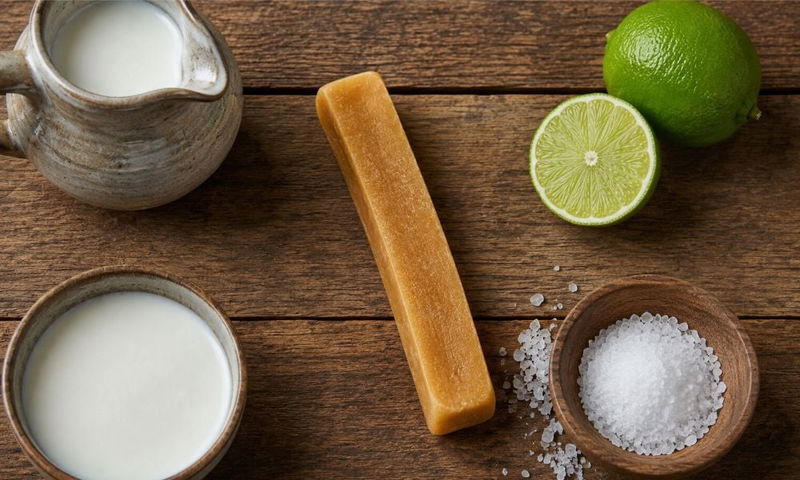
A traditional yak chew contains four ingredients: yak milk, cow milk, lime juice, and salt. Himalayan households have combined these ingredients into a hard cheese called chhurpi for generations, originally as a way to preserve surplus milk through winter. Producers heat the milk mixture, curdle it with lime juice, press out the moisture, and smoke-dry or sun-dry the blocks until the water activity drops low enough to prevent spoilage without refrigeration. A 2023 peer-reviewed study in the Journal of Ethnic Foods documented annual export growth of 10 to 11 percent for Nepali chhurpi producers over five consecutive fiscal years, reflecting the shift of a regional food staple into an international pet product category.
Why Have Yak Chews Become a Popular Choice for Dogs?
Dog owners gravitate toward yak chews for four reasons: a single-ingredient recipe with no fillers or preservatives, a chew session that stretches across weeks instead of minutes, a dry, low-odor texture that does not stain carpet or leave grease on furniture, and a byproduct-based supply chain that appeals to sustainability-minded buyers. Chewing itself also serves a behavioral purpose. Dogs are natural chewers, and a long-lasting chew reduces destructive chewing on furniture, shoes, and baseboards by giving that instinct a legitimate outlet.
Do Veterinarians Recommend Yak Chews?
Veterinarians recommend yak chews conditionally, not universally. Recommendation depends on the individual dog's dental health, age, chewing style, and jaw strength, the same variables veterinarians weigh before recommending any hard chew.
What Do Veterinarians Generally Say About Yak Chews?
Veterinary dentists generally classify yak chews as a hard chew that requires the same scrutiny applied to antlers, bones, and hooves. The concern centers on tooth fracture risk. Veterinary dental specialists commonly apply the "kneecap rule," attributed to veterinary dental specialist Dr. Fraser Hale: if an owner would not want to be struck in the kneecap with the object, a dog should not be chewing on it. A companion test, the thumbnail test, asks whether the chew yields slightly under fingernail pressure; if it does not indent at all, it likely exceeds the hardness a dog's tooth enamel can safely absorb. Yak chews sit close to this threshold, which is precisely why sizing, supervision, and moderation matter more with yak chews than with softer treats. A cadaveric study published in Frontiers in Veterinary Science modeled the compressive forces required to fracture a dog's upper fourth premolar, the tooth most commonly fractured during hard chewing, and found that tooth fracture in dogs already carries a documented prevalence of 20 to 27 percent across the general dog population, independent of any single chew product.
Which Dogs Are Good Candidates for Yak Chews?

Four dog profiles make good candidates for yak chews: adult dogs with full, healthy adult dentition; dogs with a deliberate, gnawing chewing style rather than an aggressive crushing bite; dogs without a history of tooth fractures or root canal treatment; and dogs that tolerate supervised chewing sessions of 15 to 30 minutes rather than unsupervised all-day access. Medium and large adult dogs generally handle yak chews well because their jaw structure distributes chewing force across a broader tooth surface. Moderate chewers who work a treat slowly, rather than dogs that bite down with full crushing force on the first contact, carry a lower fracture risk on any hard chew, yak chews included.
A dog's chewing style matters as much as its size. A dog that mouths a chew slowly for twenty minutes before making progress behaves differently from a dog that clamps down at full bite force within the first minute, even at the same body weight. The second dog needs a larger, denser size to compensate for that bite force. Breeds developed for working jaw strength, including many terriers, mastiff-type breeds, and livestock guardian breeds, tend to fall into the higher-force chewing category regardless of body weight, so owners of these breeds commonly size up beyond the standard weight bracket rather than sticking to it.
When Might Veterinarians Recommend Avoiding Yak Chews?
Veterinarians commonly advise against yak chews for five groups: puppies under six months of age, whose deciduous teeth are structurally more brittle than adult teeth; senior dogs with age-related enamel wear or periodontal disease; any dog with a prior tooth fracture, root canal, or crown; dogs diagnosed with aggressive or "power chewing" behavior that generates unusually high bite force; and dogs recovering from recent dental surgery. Permanent teeth begin erupting in most dogs around three months of age, and full adult dentition is not complete until roughly six to seven months, according to veterinary dental research on tooth eruption timing. Introducing a dense chew before that window closes raises the odds of damaging a tooth that has not finished forming.
Dogs recovering from a dental procedure need a longer waiting period than owners typically expect. A tooth extraction site or root canal repair needs weeks, not days, to stabilize, and a hard chew introduced too soon can reopen the surgical site or fracture an adjacent tooth still adjusting to a changed bite pattern. Any dog with visibly worn, yellowed, or chipped teeth from a previous chewing habit falls into the same avoidance category, since existing enamel damage lowers the force needed to cause a full fracture. In each of these cases, a veterinary dental exam before reintroducing hard chews of any kind, not only yak chews, gives a clearer answer than guessing based on the dog's age alone.
What Are the Benefits of Yak Chews?
Yak chews offer three primary benefits recognized across veterinary and behavioral sources: mechanical dental cleaning, sustained mental stimulation, and extended chew duration compared with most commercial alternatives.
How Can Yak Chews Support Dental Health?
Yak chews support dental health through abrasive mechanical action rather than chemical or enzymatic action. As a dog gnaws the hardened cheese, the chew's surface scrapes soft plaque off the tooth crown before it mineralizes into tartar. This mechanism only works as prevention, not treatment; a yak chew removes surface plaque but does not reverse existing tartar buildup or periodontal disease, and it does not substitute for brushing, professional cleanings, or products carrying the Veterinary Oral Health Council (VOHC) seal of acceptance. Owners managing a dog with early tartar accumulation often use a yak chew as one part of a broader dental routine rather than a standalone solution.
The cleaning effect concentrates on the carnassial and premolar teeth, the same teeth a dog uses to grip and break down the chew, and does little for the incisors at the front of the mouth. A dog that chews on only one side of its jaw builds up plaque unevenly, cleaning one row of teeth while leaving the opposite side untouched. Rotating which side of the mouth a chew session favors, something owners can influence by how they position the chew when handing it over, helps distribute the mechanical cleaning benefit more evenly across the mouth.
How Do Yak Chews Promote Mental Stimulation?
Extended gnawing engages a dog's natural foraging and problem-solving instincts, occupying the same behavioral drive that fuels destructive chewing when left unaddressed. A 20-minute chew session lowers cortisol through repetitive jaw movement in the same way a slow, repetitive task calms a person's nervous system. Dogs left alone for long stretches during a workday, or dogs recovering from surgery and restricted to crate rest, often benefit most from this stimulation, since a yak chew gives them a contained, low-impact activity that does not require running or jumping.
Dogs with separation-related distress often respond well to a chew introduced a few minutes before an owner leaves the house, since starting the activity before the trigger event shifts the dog's focus onto the chew rather than the departure itself. This works best as one tool among several, alongside a consistent departure routine and a safe, confined space, rather than a stand-alone fix for anxiety-driven behavior. Puzzle-style enrichment and scent work offer similar cognitive engagement for dogs that cannot safely have a hard chew, giving owners of puppies or senior dogs a comparable outlet without the fracture risk.
Why Are Yak Chews Considered a Long-Lasting Natural Chew?
A single yak chew commonly lasts a moderate chewer anywhere from several days to several weeks, compared with minutes for a rawhide strip or a fraction of an hour for a typical bully stick. Three factors drive that longevity: low moisture content from the drying process, a dense protein-fat matrix that resists breaking apart under normal jaw pressure, and a smoking or sun-curing step that hardens the outer layer further. Owners who rotate a single chew back into use across multiple short sessions, rather than leaving it out continuously, typically stretch that lifespan even further while keeping wear on the teeth within a manageable range per session.
Are Yak Chews Safe for Dogs?
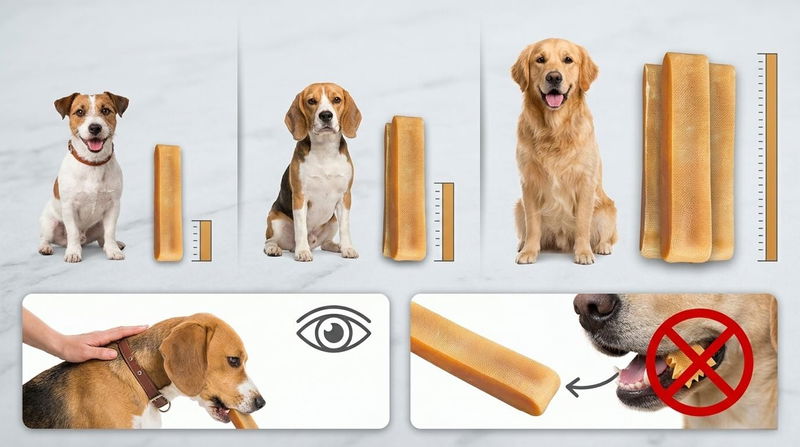
Yak chews are safe for most healthy adult dogs when sized correctly, given under supervision, and used in moderation rather than as a daily default chew. Safety hinges less on the product itself and more on matching the chew to the individual dog's dental condition, size, and chewing behavior.
What Risks Do Veterinarians Commonly Mention?
Veterinarians cite three recurring risks with yak chews: dental fracture from excessive hardness, choking on a piece broken off mid-chew, and gastrointestinal obstruction from a swallowed chunk too large to pass. The fracture risk applies mainly to the carnassial teeth used for the heaviest chewing force. The obstruction risk applies mainly to end-stage pieces, once a chew has worn down to a size a dog can swallow whole rather than continue gnawing. Both risks scale with how aggressively an individual dog bites down, not simply with the product category as a whole.
A fractured tooth does not always announce itself immediately. A dog can continue eating and playing normally for days after a slab fracture, showing only subtle signs such as chewing exclusively on one side, dropping food mid-meal, or pawing at the face after a chewing session. Left untreated, an exposed pulp chamber becomes a route for chronic bacterial infection, which is why veterinary dentists treat any suspected fracture as urgent even when the dog shows no obvious pain. Gastrointestinal obstruction, by contrast, tends to announce itself faster, with vomiting, loss of appetite, straining, or lethargy appearing within 24 to 48 hours of swallowing an oversized piece, and it typically requires same-day veterinary evaluation rather than a wait-and-see approach.
How Can Owners Reduce the Risk of Injury or Choking?
Five practices lower the injury risk associated with yak chews: supervising every chew session rather than leaving a dog unattended with the chew, matching chew size to the dog's weight and jaw size rather than defaulting to the cheapest option, inspecting the chew periodically for cracks or sharp edges, keeping fresh water available during chewing to ease swallowing, and removing the chew once it reaches a size the dog could swallow in one bite. A dog that gags, paws at its mouth, drools excessively, or refuses to keep chewing is showing early signs that a piece has lodged somewhere it should not be, and that session should stop immediately.
What Size and Chewing Habits Improve Safety?
Sizing a yak chew up, rather than down, improves safety in almost every case. A 70-pound dog can swallow a medium-sized chew whole with little resistance, while a 15-pound dog given a large chew simply takes longer to work through it; the larger size costs time, not safety. The safer rule of thumb ties chew size to body weight: small dogs under 20 pounds need the smallest available size, medium dogs between 20 and 50 pounds need a step up, and dogs above 50 pounds need the largest size the trusted dog chew manufacturer offers. Dogs with a fast, aggressive chewing style need a size larger than their weight bracket would otherwise suggest, since their bite force works through the chew faster than a deliberate chewer's.
How Do Yak Chews Compare With Other Dog Chews?
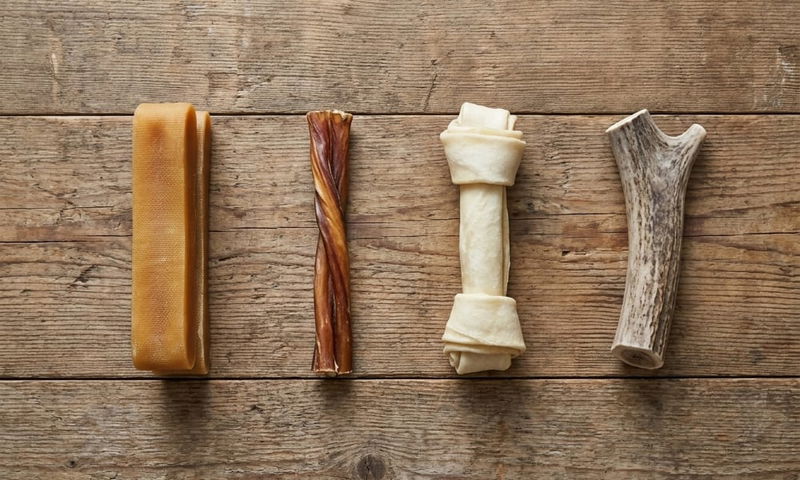
Yak chews occupy a different risk and duration profile than rawhide, bully sticks, and synthetic chews. Each alternative trades one risk for another rather than eliminating risk outright.
How Do Yak Chews Compare With Rawhide and Bully Sticks?
Rawhide carries a higher obstruction risk than yak chews because rawhide softens as a dog chews it, and large softened pieces can lodge in the esophagus or intestine without breaking down. Rawhide processing also commonly involves bleaching and chemical treatment for shelf stability, which raises separate concerns about chemical residue that yak chews, cured only with milk, lime juice, and salt, do not share. Bully sticks sit at the opposite end of the hardness spectrum from yak chews: they are fully digestible and rarely cause fracture, but they last only a fraction of the time a yak chew does and require the same end-stage vigilance against swallowing a small final piece. Yak chews fall between the two on the durability-versus-digestibility spectrum: harder and longer-lasting than a bully stick, but more digestible and less chemically processed than commercial rawhide.
Bacterial contamination is a shared concern across all three natural chew categories, not one specific to yak chews. Rawhide, bully sticks, and yak chews can each carry Salmonella or other bacteria if drying and packaging fall short of proper standards, which is why sourcing matters more than the raw material itself. A yak chew produced in a facility with documented water-activity testing and batch-level lab verification carries a materially lower contamination risk than a low-cost import with no traceable manufacturing record, regardless of which of the three chew types is under comparison.
What Makes Yak Chews Different From Synthetic Chews?
Synthetic chews made from nylon or hard plastic do not break down in the digestive tract at all, so a swallowed fragment cannot be digested and typically requires veterinary removal if it does not pass on its own. Yak chews are fully digestible in small pieces, meaning a dog's stomach acid can break down a properly sized bite over time, which shifts the primary risk profile toward fracture and short-term choking rather than permanent, non-digestible blockage. Synthetic chews also carry no nutritional value, while yak chews deliver a high-protein, low-fat profile derived directly from dairy.
Manufacturers with FDA-registered facilities and HACCP-certified production, such as YforYak, test each batch for water activity and moisture content specifically to keep the finished chew within a hardness range that supports digestibility without sacrificing the durability owners expect from the product.
How Should Dog Owners Choose and Use Yak Chews?
Choosing a safe yak chew starts before purchase, with ingredient transparency and manufacturing standards, and continues through storage and supervised use once the chew is in the home.
What Should Owners Look for in a High-Quality Yak Chew?
Five quality markers separate a well-made yak chew from a poorly made one: a short, recognizable ingredient list limited to yak milk, cow milk, lime juice, and salt; no artificial whitening, bleaching, or preservative treatment; documented lab testing for contaminants and moisture content; clear country-of-origin labeling; and third-party or regulatory certification such as HACCP, FDA registration, or ISO 9001. Chews that list vague terms like "natural flavoring" or that arrive unusually pale or uniform in color often indicate chemical processing rather than traditional smoke- or sun-curing.
Texture offers a quick field check at the point of purchase. A traditionally cured yak chew has a slightly uneven surface, a faint smoky or dairy smell, and a color ranging from pale cream to light amber depending on curing method, rather than a bright, bleached white. Weight is another indicator: a properly dried chew feels dense for its size, since low residual moisture is what gives it both its long shelf life and its hardness. A chew that feels unusually light or slightly tacky to the touch may carry higher moisture content than is safe for long-term storage, raising the odds of mold rather than fracture risk.
How Should Yak Chews Be Used and Stored Safely?
Yak chews store best in a cool, dry, airtight container away from direct sunlight and humidity, both of which soften the chew and shorten its usable life. During use, sessions of 15 to 30 minutes under direct supervision strike a practical balance between dental benefit and fracture risk, rather than leaving the chew accessible around the clock. Rotating a chew in and out of storage between sessions also gives an owner a natural checkpoint to inspect it for cracks, splintering, or a shrinking size that signals it is nearing the point of replacement.
Households with more than one dog need a separate chew for each animal rather than a shared one. Resource guarding around a high-value chew is a common trigger for fights between otherwise well-matched dogs, and separating chewing sessions by room or crate removes that flashpoint entirely. Owners introducing a yak chew to a dog for the first time do well to run the first session for only five to ten minutes and watch for any of the warning signs described above before extending future sessions to the full 15 to 30 minute range.
What Should Be Done With Small Leftover Pieces?
A yak chew should be removed once it wears down to roughly two inches in length or becomes small enough for the dog to fit entirely in its mouth. At that stage, owners have two practical options: discard the remaining piece and trade it for a different treat, or soften it into a smaller, digestible form. A widely shared technique among yak-chew owners, sometimes called the "puff hack," involves microwaving the leftover piece in short intervals until it puffs into a light, airy, easily chewed treat, eliminating the fracture risk for the final portion.
What Are the Key Takeaways About Veterinarian Opinions on Yak Chews?
Veterinarian opinion on yak chews is neither a blanket endorsement nor a blanket ban. The consensus that does exist rests on a few clear points:
Healthy adult dogs with a deliberate chewing style are generally good candidates for yak chews under supervision.
Puppies under six months, senior dogs with dental wear, and dogs with a history of tooth fracture face a higher risk and typically warrant an alternative or a veterinary consultation first.
Dental fracture, choking, and gastrointestinal obstruction are the three risks veterinarians raise most often, and all three scale with chew size, chewing style, and supervision rather than the product category alone.
Sizing a chew up rather than down, supervising every session, and removing pieces once they shrink to a swallowable size address most of the documented risk.
Compared with rawhide, bully sticks, and synthetic chews, yak chews sit in a middle position: more durable and digestible than rawhide's chemical-treatment profile, harder and longer-lasting than a bully stick, and nutritionally superior to any non-digestible synthetic option.
Owners weighing a yak chew for the first time gain the most value from an individual assessment of their own dog's teeth, age, and chewing habits, ideally confirmed with a veterinarian during a routine dental check, rather than relying on general safety claims alone.
Comments
No comments yet. Be the first to comment!