When Is the Best Time for the Khopra Ridge Trek? Complete Seasonal Guide
Plan your Khopra Ridge Trek with month-by-month weather, seasonal trail conditions, temperatures, mountain visibility, packing advice, and expert tips to choose the perfect time to visit Nepal's hidden Himalayan viewpoint.
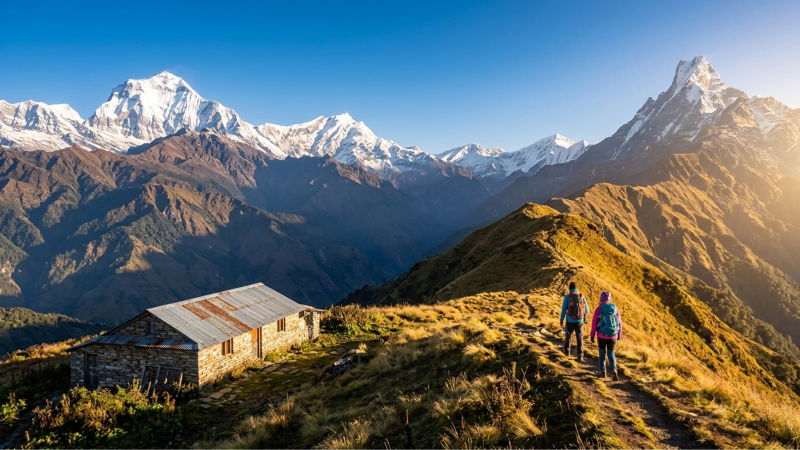
Spring (March to May) and autumn (September to November) are the best times for the Khopra Ridge Trek. These two windows deliver the driest trails, the widest temperature comfort zone at 3,660 meters, and the clearest sightlines to Dhaulagiri, Annapurna South, and Nilgiri. Spring brings blooming rhododendron forests along the Khopra Ridge route; autumn offers the clearest mountain visibility of the year.
Nepal's Himalaya operates on four climate blocks: pre-monsoon spring, wet summer monsoon, post-monsoon autumn, and dry winter, and each one reshapes the Khopra Ridge Trek differently. Altitude does the rest: the trail climbs from Ghandruk at 1,940 meters to the ridge itself at 3,660 meters, with the Khayer Lake side trip reaching 4,500 to 4,660 meters. A 20-degree temperature swing between trailhead and summit is normal on any single day, in any month. The sections below break down exactly what that means for weather, trail surface, crowds, and gear, month by month and season by season.
What Makes the Best Time to Trek Khopra Ridge?
The best time to trek Khopra Ridge combines dry trails, stable afternoon weather, and unobstructed peak visibility. Three conditions define a strong trekking window: rainfall low enough to keep stone steps and ridge paths from turning slick, temperatures mild enough for comfortable nights above 3,000 meters, and cloud cover light enough to reveal Dhaulagiri and Annapurna South from the ridge.
Spring and autumn satisfy all three conditions at once. Winter satisfies two, dry trails and clear skies, but fails the temperature test, with ridge nights regularly dropping below -10°C. Monsoon fails on trail surface and visibility, since daily rainfall turns the Ulleri stone staircase and the descent to Swanta into a slick, leech-prone hazard while afternoon cloud buildup hides the peaks the trek is built around.
A common planning mistake is to treat "best season" as a single, fixed answer. The right window depends on which of the three conditions matters most to an individual trekker: a photographer optimizes for clear skies, a budget traveler optimizes for low lodge rates, and a first-time high-altitude hiker optimizes for temperature stability over raw visibility.
How Do Weather, Visibility, and Trail Conditions Affect the Experience?
Weather on Khopra Ridge changes the experience on three levels: comfort, safety, and reward. Rain softens stone steps into a slip hazard, cold turns a routine ridge walk into a serious altitude exposure, and cloud cover can erase the exact panorama most trekkers come to see.
Trail surface shifts dramatically by season. The stone staircase between Ulleri and Ghorepani carries thousands of trekkers' footsteps each year; in monsoon, that same staircase becomes a running channel for rainwater. Above Dobato, the path to Khopra Ridge crosses open alpine pasture with no tree cover, so wind and sudden fog move in faster than on forested lower sections, a pattern the Khopra Ridge Trek route guide flags as the trail's single most weather-exposed stretch.
Visibility follows a less obvious pattern than most trekkers assume. Autumn produces Nepal's cleanest air because monsoon rainfall washes dust and smoke out of the atmosphere before the dry season begins. Spring visibility is good but less consistent, since farmers across the mid-hills burn crop residue and dry vegetation between March and May, adding haze below roughly 4,000 meters. Because Khopra Ridge tops out at 3,660 meters, below that haze ceiling, spring afternoons on the ridge can occasionally soften mountain outlines that were sharp at sunrise. Morning treks in spring consistently outperform afternoon treks for photography on this route.
Which Factors Should Trekkers Consider Before Choosing a Season?
Trekkers weigh five factors before selecting a season: temperature tolerance, rain and snow exposure, visibility priority, crowd preference, and physical fitness for cold-weather trekking. Each factor points toward a different month, so ranking personal priorities matters more than chasing a single "best" answer.
Temperature tolerance determines whether winter's -10°C to -15°C ridge nights are workable or whether spring and autumn's milder 0°C to 5°C range fits better.
Rain and snow exposure rule out monsoon for anyone without leech socks and flexible dates, and rule out deep winter for anyone without cold-rated gear.
Visibility priority favors autumn above every other factor, since October and November hold the year's most consistent clear-sky record.
Crowd preference favors shoulder months, late March, early June, or December, for trekkers who want quiet lodges without monsoon or deep-winter risk.
Physical fitness for cold-weather trekking matters most for the optional Khayer Lake side trip at 4,500 meters, where thin air and ice combine outside the spring-autumn window.
A frequent oversight involves the elevation profile of the route itself. Trekkers who check only Pokhara's forecast, sitting at 820 meters, consistently underestimate conditions at Dobato and Khopra Ridge, where temperature and wind behave nothing like the valley floor.
What Is the Month-by-Month Weather on the Khopra Ridge Trek?
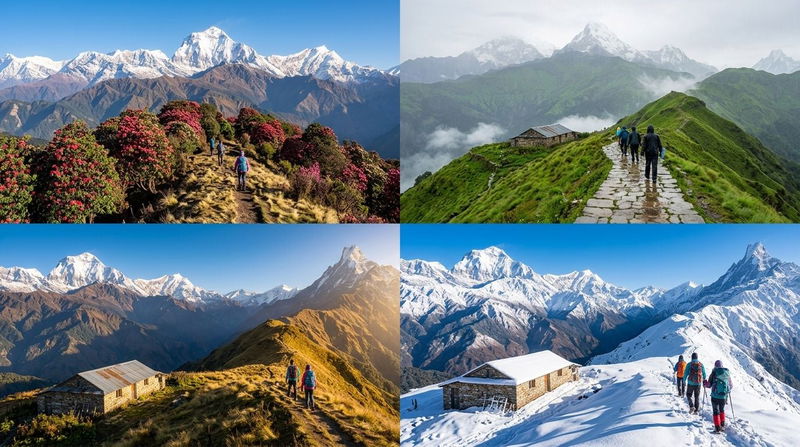
Khopra Ridge weather moves through four distinct blocks across twelve months: a cold, dry winter from December to February; a warming, blooming spring from March to May; a wet monsoon from June to September; and a crisp, clear autumn from September to November. The breakdown below covers ridge-level conditions at 3,660 meters alongside lower-trail conditions near Ghandruk and Tadapani.
January
Ridge daytime temperatures hold between 2°C and 6°C, dropping to -10°C to -15°C overnight. Snow accumulates above 3,000 meters, occasionally closing the final stretch to Khopra Ridge and making the Khayer Lake side trip unsafe without microspikes. Skies stay dry and clear for most of the month, since winter in Nepal produces minimal precipitation. Trails are near-empty, and a handful of community lodges reduce services during the coldest weeks.
February
Conditions mirror January with a gradual warming trend. Ridge daytime highs reach 4°C to 8°C, nights average -6°C to -12°C. Lower-elevation snow begins melting by late February, though the ridge itself often holds a snow layer through the entire month. Clear, dry weather continues, making February a strong choice for cold-tolerant trekkers who prioritize solitude over comfort.
March
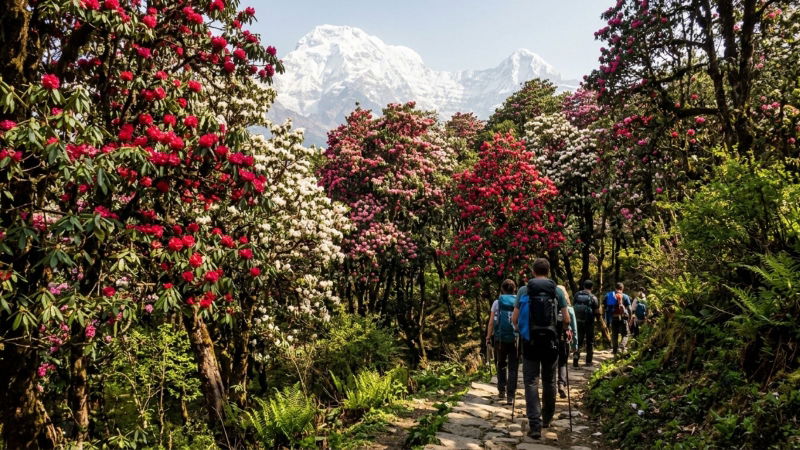
Early spring brings the season's first real warmth. Ridge daytime temperatures climb to 8°C to 12°C, with nights around -2°C to -4°C. Lower villages near Ghandruk see daytime highs of 15°C to 18°C. Rhododendron forests below 2,500 meters begin flowering in the second half of the month. Occasional pre-monsoon thunderstorms appear, but trails stay largely dry and dust-free.
April
Peak rhododendron season arrives, with forests around Tadapani, Dobato, and Ghorepani reaching full bloom between 2,500 and 3,500 meters. Ridge daytime temperatures range from 10°C to 15°C, dropping to 0°C to -2°C at night. Lower valley temperatures reach 20°C to 24°C. This is the busiest spring month on the trail, and afternoon haze from seasonal crop burning can soften long-distance views below 4,000 meters, a trade-off against April's floral peak.
May
Late spring brings the warmest pre-monsoon temperatures of the year. Ridge daytime highs reach 12°C to 16°C, nights stay around 2°C to 4°C. Lower valleys turn hot and humid, with daytime readings of 22°C to 26°C. Rhododendron blooms persist at the highest elevations near 3,500 to 3,800 meters even as lower forests finish flowering. Afternoon cloud buildup and occasional thunderstorms increase toward month's end, signaling the approaching monsoon.
June
The monsoon typically enters Nepal around June 13, according to the Department of Hydrology and Meteorology. Early June still offers workable trekking with warm, humid days near 15°C to 18°C at ridge elevation. By mid-month, daily afternoon rainfall begins, trails soften, and leeches appear in the lower forest sections between Ghandruk and Tadapani.
July
Monsoon rainfall peaks. Heavy afternoon and overnight downpours are routine, cloud cover obscures the peaks for most of the day, and steep sections of trail carry a real landslide risk. Myagdi District, which contains the Khopra Ridge route, recorded severe monsoon flooding and landslide damage in 2020. Leeches are common in forested stretches, and the Khayer Lake side trip is not advisable due to exposed, saturated terrain.
August
Conditions remain close to July's, with slightly reduced but still substantial rainfall by late month. High humidity and persistent cloud cover continue, and trail surfaces stay muddy and slippery throughout the route. Trekking numbers on Khopra Ridge drop to their yearly low, rewarding the few who go with unusually lush, green hillsides.
September
The monsoon typically withdraws from Nepal in late September, though the exact date varies year to year. Early September still carries lingering rain, while the final two weeks bring visibly clearing skies and drying trails. Ridge daytime temperatures run 12°C to 16°C. September rewards trekkers willing to accept some early-month uncertainty in exchange for quiet trails and the first crisp views of the season.
October
October delivers the clearest, most stable weather of the entire year. Ridge daytime temperatures range from 10°C to 14°C, and nights fall to -2°C to 2°C. Lower valley daytime highs reach 18°C to 22°C. Rainfall is minimal, skies stay reliably blue, and Dhaulagiri, Annapurna South, and Nilgiri appear in sharp detail from the ridge. October is the single busiest month on the route, coinciding with Nepal's Dashain and Tihar festival season.
November
Excellent autumn conditions continue with a cooling trend. Ridge daytime temperatures drop to 6°C to 10°C, nights fall to -6°C to -8°C by month's end. Skies remain predominantly clear and dry, holding much of October's visibility advantage while trail traffic thins out noticeably after mid-month.
December
Early winter brings a sharp temperature drop alongside continued dry, clear weather. Ridge daytime highs fall to 2°C to 6°C, with nights reaching -10°C to -14°C. The first significant snowfall of the season often arrives at Khopra Ridge and Khayer Lake. Community lodges begin scaling back services for the winter, and trails empty out fast after the first week of the month.
How Does Each Trekking Season Compare?
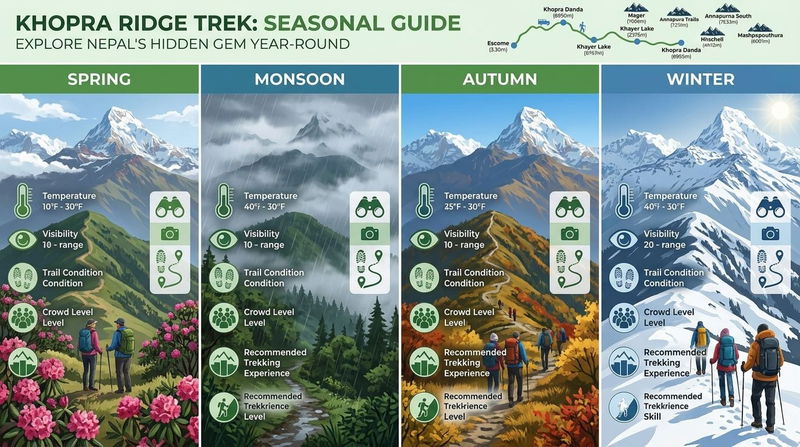
Spring and autumn outperform monsoon and winter on nearly every metric, though each of the four seasons suits a specific type of trekker. The comparison below breaks down rainfall, temperature, crowd levels, and standout features for each three-month block.
Spring (March–May)
Ridge temperature: 8°C to 16°C by day, -4°C to 4°C at night
Rainfall: Low, with occasional pre-monsoon thunderstorms in May
Trail condition: Dry and stable, dusty at lower elevations by late spring
Standout feature: Rhododendron forests in full bloom around Tadapani, Dobato, and Ghorepani
Crowd level: Moderate, peaking in April
Summer/Monsoon (June–August)
Ridge temperature: 15°C to 18°C by day, humid overnight lows
Rainfall: Heavy, concentrated in daily afternoon and overnight downpours
Trail condition: Muddy, slippery, with active leech populations in forested sections
Standout feature: Lush green landscapes and near-empty trails
Crowd level: Lowest of the year
Autumn (September–November)
Ridge temperature: 6°C to 16°C by day, -8°C to 2°C at night
Rainfall: Minimal after late September, driest air quality of the year
Trail condition: Firm, dry, and well-maintained after monsoon repairs
Standout feature: The sharpest views of Dhaulagiri and Annapurna South all year
Crowd level: Highest, peaking in October
Winter (December–February)
Ridge temperature: 2°C to 8°C by day, -6°C to -15°C at night
Rainfall: Minimal, occasional snowfall above 3,000 meters
Trail condition: Icy and snow-covered near the ridge and at Khayer Lake
Standout feature: Complete solitude on a route that already sees fewer trekkers than Annapurna Base Camp
Crowd level: Lowest outside monsoon, some lodges close
Which Season Is Best for Different Types of Trekkers?
The right season depends on trekker type: first-time trekkers do best in October, photographers split between April and November, experienced trekkers extend into December and early March, and budget travelers save the most in June and September. Matching trekker profile to season reduces both discomfort and cost.
First-Time Trekkers
October offers the most forgiving combination of mild ridge temperatures, dry trails, and reliable teahouse service, with predictable conditions that reduce the guesswork of a first high-altitude trek. Trekkers new to elevations above 3,000 meters benefit from October's stable weather pattern, which lowers the chance of a forced descent due to sudden storms.
Photographers
April rewards photographers with rhododendron forests in full color set against snow peaks, while late October and November deliver the year's clearest air for long-distance mountain shots. Morning departures matter more than season selection alone, since haze builds through the afternoon in both windows, a detail most planning guides overlook.
Experienced Trekkers
Trekkers with prior high-altitude experience extend the comfortable window into early March and December, when trails thin out and lodge rates soften, provided cold-weather gear matches the -10°C to -15°C overnight lows. Experienced trekkers with proper acclimatization also tackle the Khayer Lake side trip more confidently outside peak season, when trail traffic at 4,500 meters is lightest.
Budget Travelers
June and September offer the lowest lodge and porter rates on the route, since demand drops sharply outside the spring and autumn peaks. Trekkers willing to accept some rain risk in exchange for lower costs find early June, before the monsoon fully establishes, and mid-to-late September, as it withdraws, deliver meaningful savings without full monsoon exposure.
How Does the Weather Affect the Khopra Ridge Trek?
Weather governs four practical outcomes on Khopra Ridge: temperature range, snow accumulation, rhododendron bloom timing, and mountain visibility. Each of these variables shifts independently across the year, which is why a single "best month" rarely satisfies every trekker's priorities at once.
How Do Temperature and Rainfall Change Throughout the Year?
Temperature and rainfall move in opposite directions across the year on Khopra Ridge. Ridge temperatures peak in May and June, just before monsoon rainfall peaks in July and August, then fall sharply through autumn into winter's driest, coldest months. Trekkers planning by month benefit from tracking both variables together, since the warmest months bring the heaviest rain and the driest months bring the coldest nights.
How Does Snow Impact the Trail During Winter?
Snow above 3,000 meters accumulates from December through February, coating the final ascent to Khopra Ridge and the entire Khayer Lake side trip in a layer that ranges from a light dusting to several inches depending on the year. Snow-covered stone steps near Dobato become a slip hazard without microspikes, and the exposed ridge walk carries added wind-chill risk when snow is fresh. Guides on this route recommend microspikes and gaiters as standard winter equipment, not optional extras.
When Are Rhododendrons in Bloom?
Rhododendron blooming follows elevation, starting at lower forests below 2,500 meters in late February and March, peaking at mid-elevations between 2,500 and 3,000 meters through late March and April, and finishing at higher elevations between 3,000 and 3,800 meters in late April and May. On the Khopra Ridge route, this means the Tadapani-to-Dobato forest corridor carries the densest concentration of blooming trees during the first half of April.
Which Months Offer the Clearest Mountain Views?
October and November offer the clearest mountain views of the year, since monsoon rainfall clears dust and pollutants from the atmosphere before the dry season sets in. March and early April offer the second-strongest visibility, trailing autumn slightly due to pre-monsoon agricultural haze that builds below roughly 4,000 meters. Morning views outperform afternoon views in every season, since cloud buildup and haze both intensify as the day warms.
What Should Trekkers Pack for Each Season?
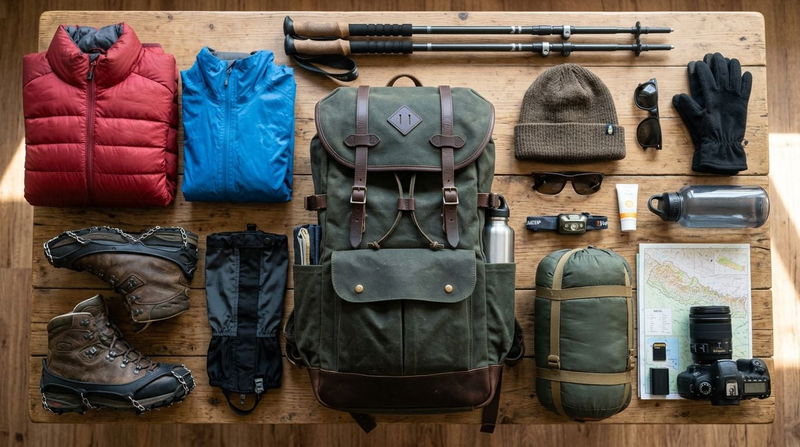
Packing for Khopra Ridge changes by season across three categories: insulation layers, rain and waterproofing gear, and traction equipment. The interactive packing checklist covers the full gear list; the season-specific priorities below cover what changes most.
Spring and Autumn Packing List
A mid-weight down jacket for ridge nights near freezing
Moisture-wicking base layers for daytime temperature swings
A sun hat and SPF lip balm, since UV exposure runs high at altitude even in cool weather
A lightweight rain shell for occasional spring thunderstorms
Standard trekking boots, since trails stay dry outside of brief spring showers
Monsoon Packing Essentials
Waterproof rain pants and a full-coverage rain jacket
Leech socks or gaiters treated with insect repellent for lower forest sections
Quick-dry clothing, since humidity prevents overnight drying of wet gear
A dry bag or pack liner to protect electronics and sleeping bags from daily rainfall
Trekking poles for extra stability on slick stone steps
Winter Trekking Gear
A sleeping bag rated to at least -15°C for nights at Khopra Ridge and Dobato
Microspikes for icy sections near the ridge and on the Khayer Lake trail
Insulated, waterproof gloves and a warm hat for wind chill on exposed ridge sections
A high-loft down jacket rated for sub-zero temperatures
Gaiters to keep snow out of boots on fresh powder days
How Can Trekkers Plan the Perfect Khopra Ridge Trek?
Planning the perfect Khopra Ridge Trek starts with matching season to priority, then building in acclimatization time before the push to Khayer Lake. Trekkers who lock in October or April dates typically book lodges four to six weeks ahead, since these peak windows fill faster on a route that still sees far fewer trekkers than Annapurna Base Camp or Ghorepani Poon Hill.
A realistic itinerary allows multiple nights above 3,000 meters before attempting Khayer Lake at 4,500 meters, since altitude-related symptoms remain a risk regardless of season. Trekkers combine seasonal research with a personal fitness check; daily hikes on this route run four to nine hours over stone steps, forest trail, and open ridge terrain, which demands a baseline fitness level beyond a casual day hike. Cross-referencing the month-by-month breakdown above against personal temperature tolerance and available vacation dates narrows the choice to a two- or three-month window before booking begins.
How Can a Local Trekking Company Help Choose the Best Time to Visit?
A local trekking company adds real-time trail knowledge that general seasonal guides cannot provide, including current snow depth, lodge availability, and week-to-week weather shifts. Guides based in Pokhara track conditions on Khopra Ridge daily, which matters most in shoulder months like early March, late May, and early December, when conditions can swing significantly within a single week.
Local operators also hold current data on which community lodges remain open during winter, which sections of trail require microspikes after a snowfall, and which specific days during monsoon offer a break in the rain pattern. This kind of week-by-week judgment sits outside what any static seasonal guide can capture, since Himalayan weather at 3,660 meters shifts faster than forecasts issued for the Pokhara valley below. Trekkers working with an established operator on this specific route gain a second layer of season selection: not just which month, but which week within that month offers the best trail conditions.
What Are the Key Takeaways About the Best Time for the Khopra Ridge Trek?
Spring and autumn remain the two strongest windows for the Khopra Ridge Trek, but the right choice depends on individual priorities around temperature, visibility, crowds, and budget. The following points summarize the full seasonal picture:
October and November deliver the clearest views and most stable weather of the year, at the cost of the busiest trails.
April delivers peak rhododendron blooms across the Tadapani-to-Dobato forest corridor, with a trade-off of occasional afternoon haze below 4,000 meters.
Monsoon (June to August) brings the lowest crowds and lowest cost, offset by muddy trails, leeches, and reduced visibility.
Winter (December to February) rewards cold-tolerant, well-equipped trekkers with total solitude and clear skies, but ridge nights fall to -10°C to -15°C.
Shoulder months, early March, early June, and September, balance moderate crowds against variable weather for trekkers with flexible dates.
The Khopra Ridge Trek rewards careful season selection more than most Annapurna routes, since its 3,660-meter ridge and 4,500-meter Khayer Lake side trip sit exposed to weather shifts that lower-elevation trails rarely face. Trekkers weighing these month-by-month and season-by-season details against personal fitness, budget, and photography goals can review the complete Khopra Ridge Trek itinerary and route guide to match a specific departure date to the conditions that matter most.
Comments
No comments yet. Be the first to comment!